
When somebody searches for “roof repair near me,” “pressure washing in Huntington,” or “plumber open now,” Google has to decide which businesses show up first.
Distance and reviews matter, but neither decides the result alone.
Google says local rankings are primarily based on three factors:
- Relevance
- Distance
- Prominence
These three factors work together. A business might be closer but less relevant. Another might have more reviews but be farther away. A third might have a strong reputation but a Google Business Profile that barely explains what the company does.
There is no single trick that guarantees a top-three Maps ranking.
The practical goal is to improve the factors you can influence while understanding the ones you can’t control.
Where Do Local Rankings Appear?
Local rankings affect the business results Google displays when it believes someone is looking for a nearby product or service.
These can include:
- The local results displayed beside a map
- Google Maps results
- Google Business Profiles appearing in search
- Searches containing “near me”
- Searches that include a city, neighborhood, or other location
Examples include:
pressure washing near meroof repair in Huntington WVemergency plumberhandyman in Ashland KYconcrete cleaning Barboursville WV
Google recognizes that the person isn’t looking for general information. They are looking for a business capable of doing a specific job in a particular area.
It then uses relevance, distance, and prominence to decide which eligible businesses deserve visibility.
Your regular website rankings and Google Maps rankings aren’t identical, but they are connected. Google specifically says a business’s position in regular search results can contribute to prominence in local results.
That’s one reason a Google Business Profile can’t completely replace a good website.
1. Relevance: Does Your Business Match the Search?
Relevance describes how closely your business matches what the customer searched for.
If someone searches for “roof cleaning near me,” Google has to determine which nearby businesses actually provide roof cleaning.
It may use information from your:
- Google Business Profile
- Primary business category
- Additional categories
- Listed services
- Business description
- Website
- Individual service pages
- Other information Google finds about the business
The clearer and more accurate this information is, the easier it is for Google to understand what your business does.

Choose the Most Accurate Business Categories
Your primary Google Business Profile category is one of the clearest ways to tell Google what type of business you operate.
Choose the category that most accurately represents the main service your company provides.
You can then add legitimate additional categories for other important parts of the business.
Don’t choose loosely related categories just because you want to appear for more searches.
For example, a pressure washing company should not select “roofing contractor” because it cleans roofs. Cleaning a roof and replacing one are two different services.
Adding more categories doesn’t automatically create more visibility. Irrelevant categories can confuse what the business actually offers and put inaccurate information in front of potential customers.
Complete Your Business Information
Google recommends keeping your Business Profile information complete and accurate.
Review your:
- Business name
- Address or service-area configuration
- Phone number
- Website
- Business hours
- Primary category
- Additional categories
- Services
- Business description
- Photos
- Appointment or estimate link
Everything should reflect how the business operates in the real world.
Don’t add services you don’t provide. Don’t cram cities and keywords into the business name. Don’t claim a fake office because you want to rank in another market.
Those aren’t clever optimization tactics. They are good ways to make the profile inaccurate and potentially create a suspension problem.
For a complete profile walkthrough, read my guide on how to optimize your Google Business Profile.
Build Clear Pages for Important Services
Your website also helps Google understand what you do.
If roof cleaning is an important service, it probably deserves a useful roof-cleaning page. Mentioning it once in a list of 27 services doesn’t give Google or the customer much to work with.
A strong service page should explain:
- What the service includes
- What problems it solves
- What properties or surfaces you work on
- How your process works
- How you protect the customer’s property
- Common questions customers ask
- Where the service is available
- How to request an estimate
You don’t need to repeat the same keyword in every paragraph.
Write a complete page that answers the questions a real customer would ask before hiring you. That’s better for search engines, and more importantly, it gives the person reading the page a reason to call.
Use the Language Your Customers Use
Customers don’t always describe a problem the same way someone in the trade would.
A pressure washing contractor might call it “organic growth on vinyl siding.” A homeowner might search for “green stuff growing on my house.”
A roofer might call it “granule loss.” The homeowner might search for “sand in my gutters.”
Use the correct terminology, but explain recognizable problems in plain English too.
You’re not writing the page to impress another contractor. You’re writing it to help a homeowner understand that you recognize the problem and know how to fix it.
What Relevance Does Not Mean
Relevance doesn’t mean stuffing keywords into every field you can find.
Avoid:
- Adding services or cities to your official business name
- Repeating location names unnaturally in your description
- Selecting categories for services you don’t provide
- Publishing nearly identical pages for every possible keyword
- Copying service descriptions from competitors
- Adding locations you can’t realistically serve
Clarity beats repetition.
2. Distance: How Far Is the Business From the Searcher?
Distance refers to how far each potential business is from the person searching.
If the searcher doesn’t name a location, Google uses what it knows about that person’s location.
If someone searches for “plumber in South Point, Ohio,” Google considers the location included in the search.
Distance is the factor business owners tend to understand the least and complain about the most.
It’s also the factor you have the least control over.
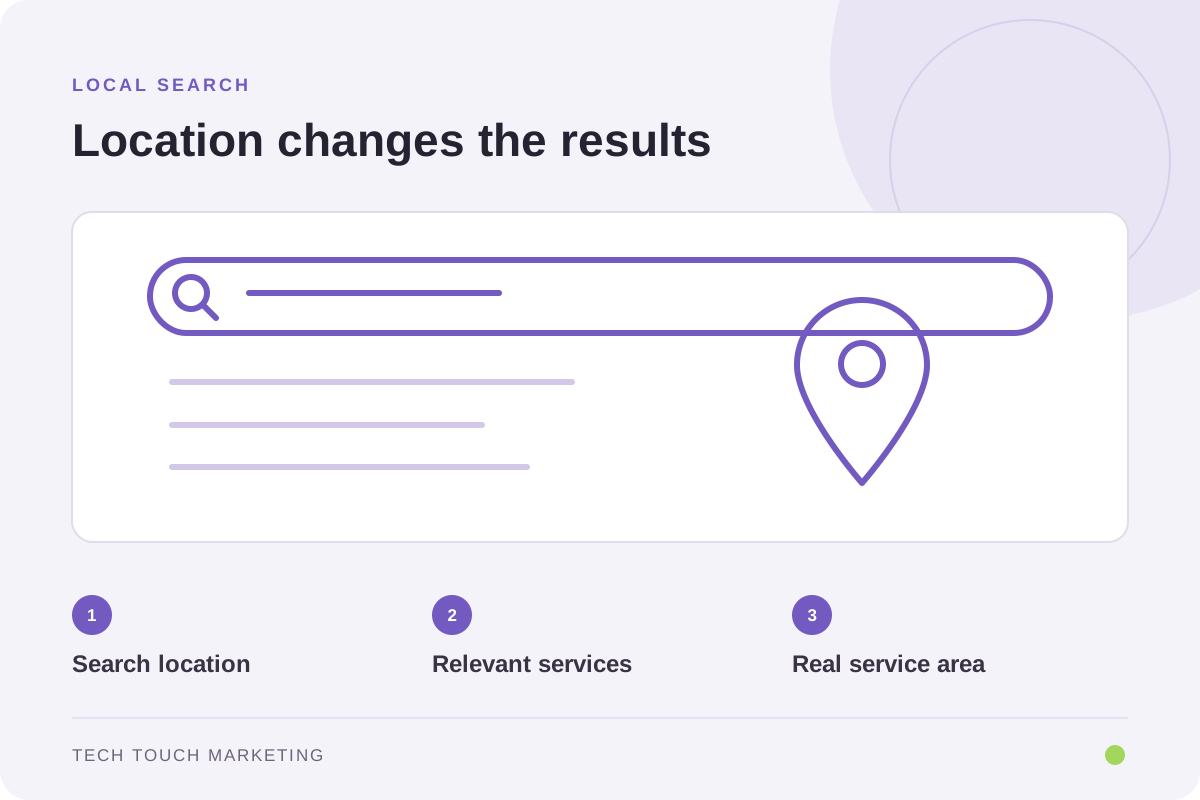
Your Ranking Can Change Across Town
Your business might appear near the top when someone searches two miles from your location and barely appear when someone performs the same search 15 miles away.
Nothing on your profile necessarily changed.
The searcher moved.
That means there is no single answer to:
“Where do I rank for pressure washing?”
The honest answer is:
“For which search, from which location?”
Local rankings can change between neighborhoods, ZIP codes, cities, and individual searchers.
A screenshot showing your business in the top three from one location doesn’t prove that you hold the same position throughout your entire service area.
This is also why manually checking from your own phone can give you a distorted picture. Google knows your location and may also have information about your previous searches and interactions.
Service Areas Do Not Remove the Distance Factor
Service-area businesses can tell Google which areas they travel to serve.
That doesn’t mean selecting 20 cities makes the company equally competitive in all 20.
Your service-area settings describe where you operate. They don’t move the business or let you choose where it ranks.
A contractor based in Huntington can’t add Charleston as a service area and expect Google to treat the company as if it were physically located in Charleston.
You may still earn organic visibility in farther markets through useful location pages, completed projects, local links, and other legitimate evidence. However, proximity remains part of local Maps rankings.
Do Not Create Fake Locations
Some businesses try to overcome distance by creating profiles at:
- Virtual offices
- Rented mailboxes
- Employees’ homes
- Friends’ addresses
- Buildings where the company doesn’t actually operate
- Multiple questionable “locations” created only for rankings
This is a bad idea.
Fake locations can lead to verification problems, suspended profiles, removed reviews, and lost visibility.
A legitimate staffed location that meets Google’s eligibility requirements is different. Renting an address just to plant another pin on the map isn’t a real expansion strategy.
It’s a shortcut until Google notices.
What Can You Do About Distance?
You can’t optimize your way into being physically close to every potential customer.
You can:
- Define your service area honestly
- Prioritize markets you can serve profitably
- Build useful pages for important locations
- Publish projects completed in those areas
- Include genuine local photos and customer reviews
- Earn legitimate local links and mentions
- Strengthen your organic visibility outside your immediate Maps radius
- Use Google Ads when faster visibility in a farther market makes financial sense
If an important market is too far away for consistent Maps visibility, the realistic options may be stronger organic SEO, paid search, or a legitimate physical expansion.
Adding the city name to 14 different fields isn’t going to make Google forget how geography works.
3. Prominence: How Established Is the Business?
Prominence describes how well-known and established a business appears.
Google looks at information from across the web, not only what you enter into your Business Profile.
According to Google, prominence can be influenced by factors such as:
- Links pointing to your website
- Review count
- Review ratings
- Your position in regular search results
- Information Google finds about the business online
- Recognition the business has earned offline
Prominence isn’t simply a contest to see who can collect the most reviews.
Google is trying to understand whether the business is legitimate, established, and trusted enough to deserve visibility.
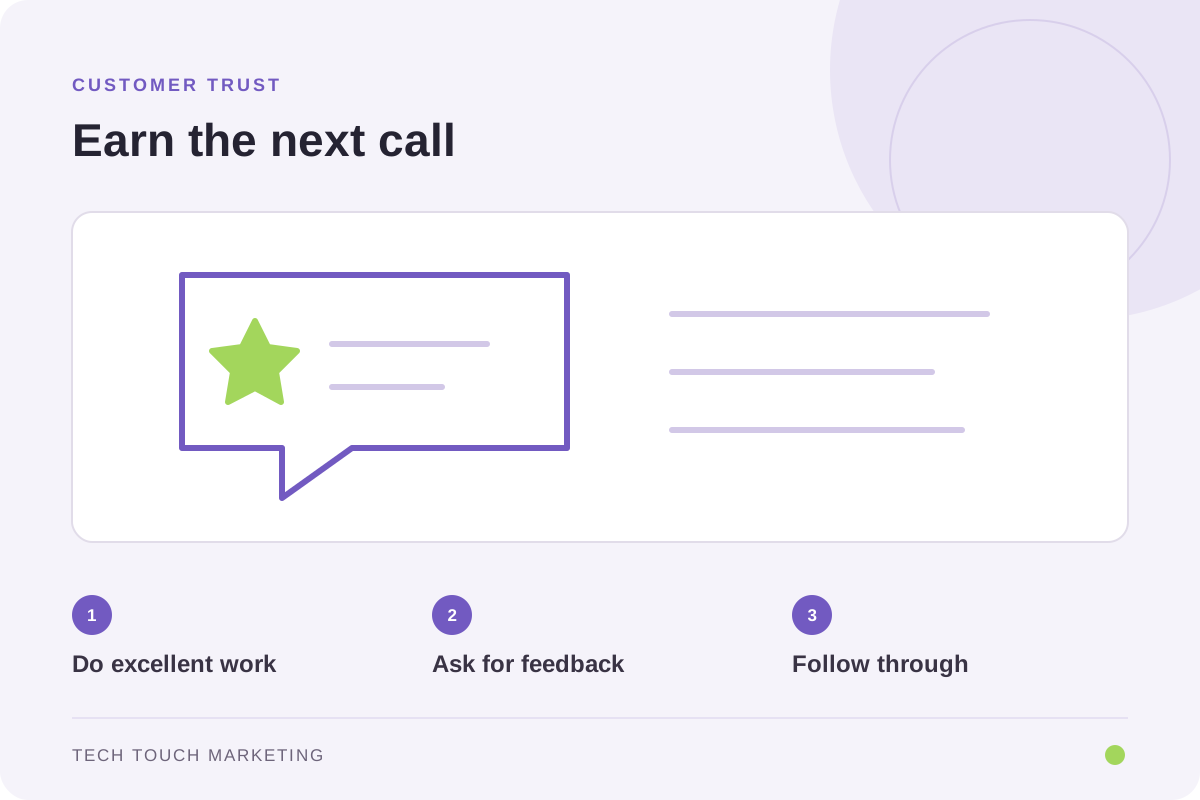
Earn Customer Reviews Consistently
Google says more reviews and positive ratings can help local rankings.
That doesn’t mean the business with the most reviews automatically wins.
Reviews are one signal among several. They also matter for a much simpler reason: customers read them.
A potential customer is looking for answers to questions like:
- Does this company show up when promised?
- Do they communicate clearly?
- Do they stand behind their work?
- Are customers consistently satisfied?
- How do they handle problems?
- Does this look like a real business I can trust?
Build review requests into your normal job-completion process.
A simple process works:
- Complete the job.
- Confirm the customer is satisfied.
- Fix any legitimate problems.
- Ask for an honest review.
- Send the direct Google review link.
- Follow up once if appropriate.
- Respond professionally to the review.
Don’t buy reviews, write reviews for customers, or offer rewards in exchange for positive feedback.
You want genuine evidence from real customers. You don’t want the profile to suddenly gain 47 glowing reviews from people who live three states away and all write like the same suspiciously enthusiastic robot.
Earn Legitimate Links and Local Mentions
Links and mentions can help Google understand your business’s reputation and relationship to its community or industry.
Useful opportunities may include:
- Chambers of commerce
- Trade associations
- Suppliers
- Manufacturers
- Community organizations
- Charities
- Sponsorships
- Local events
- Professional partners
- Local news coverage
- Project collaborations
- Local business features
A good test is:
Would this relationship make sense if Google did not exist?
If the answer is yes, it may be worth pursuing.
Buying hundreds of links from unrelated websites isn’t the same as building local prominence.
A contractor in West Virginia doesn’t need 600 links from websites about cryptocurrency, dog food, casino bonuses, and celebrity haircuts.
Low-quality links add little value. Put the effort into relevant local and industry relationships.
Strengthen Your Website
Your website helps customers and Google evaluate the business.
A strong local service website should clearly explain:
- What you do
- Where you work
- Who you help
- Why someone should trust you
- What your completed work looks like
- How to request an estimate
- What happens after someone contacts you
Individual service pages, useful location pages, documented projects, customer reviews, and genuinely helpful articles can all strengthen your online presence.
Your website doesn’t need to contain 500 pages.
It needs to be clear, useful, technically sound, and supported by real evidence.
For the complete strategy, read my guide to local SEO for service businesses.
Build a Business People Actually Recognize
Prominence isn’t created entirely online.
A business can become better known through:
- Years of serving the community
- Branded vehicles
- Local partnerships
- Sponsorships
- Community involvement
- Consistent customer service
- Referral relationships
- High-profile projects
- Media coverage
- A recognizable local reputation
Marketing can communicate that reputation. It can’t manufacture years of trust overnight.
This is why a newer company may struggle against an established competitor even when the newer company has a better-looking website.
The competitor may have years of reviews, customers, links, searches, referrals, and community recognition working in its favor.
That doesn’t mean the newer company can’t compete. It means there is real work to do.
How Relevance, Distance, and Prominence Work Together
Suppose someone searches for “roof cleaning near me.”
Google may consider:
Relevance: Does the company clearly provide roof cleaning? Are its categories accurate? Does the profile contain complete information? Does the website have a useful roof-cleaning page?
Distance: How far is the business from the searcher? Did the person specify a city? Which eligible businesses are reasonably close to that location?
Prominence: How established is the company? Does it have genuine reviews, relevant links, organic visibility, completed projects, and other evidence that customers know and trust it?
Google weighs these factors together.
That’s why:
- The closest business doesn’t always rank first.
- The business with the most reviews doesn’t always rank first.
- The business with the largest website doesn’t always rank first.
- Completing every profile field doesn’t guarantee first place.
- No legitimate marketing company can guarantee a particular Maps position.
Google doesn’t publish the exact weight given to each factor.
Anyone claiming to know the precise formula is guessing, selling something, or enjoying an unhealthy amount of confidence.
What Can a Local Service Business Actually Control?
You can’t control where every customer searches from.
You can’t control every competitor.
You can’t directly control Google’s algorithm.
You can control whether Google and potential customers find clear, accurate, and convincing information about your business.
Improve Relevance
- Choose the most accurate primary category.
- Add only legitimate additional categories.
- Complete your Business Profile accurately.
- List services you actually provide.
- Build useful pages for your priority services.
- Explain customer problems in plain language.
- Keep important business information consistent.
Build Prominence
- Ask customers for honest reviews.
- Respond professionally to reviews.
- Document completed projects.
- Publish useful service and location content.
- Earn relevant local and industry links.
- Keep important online listings accurate.
- Participate in legitimate local organizations and partnerships.
- Strengthen the website’s organic visibility.
Work With Distance
- Identify your most profitable service areas.
- Prioritize nearby markets first.
- Build location pages only when they serve a real purpose.
- Use genuine projects, photos, and customer evidence from those markets.
- Measure rankings from multiple locations.
- Consider paid search for farther or more competitive markets.
- Expand physically only when the business case supports it.
Common Myths About Google’s Local Rankings
“Adding More Cities to My Service Area Will Make Me Rank There”
Not necessarily.
Service areas describe where you operate. They don’t give your business a physical presence in every city you select.
“The Business With the Most Reviews Always Ranks First”
No.
Reviews can help, but Google considers multiple factors. Relevance and distance still matter, along with other prominence signals.
The company with 300 reviews can still be a poor match for a particular search or too far from the person searching.
“Posting on My Profile Every Week Will Make Me Rank Higher”
Google Business Profile updates can be useful for showing customers recent projects, offers, announcements, and business information.
Google doesn’t identify posting frequency as one of its primary local ranking factors.
Posts can support your marketing, but they should not take priority over accurate information, appropriate categories, genuine reviews, strong website pages, and legitimate local authority.
If your website form is broken and your profile has the wrong phone number, writing another Google post isn’t the priority.
“I Need Keywords in My Business Name”
Your profile should use the real name your business uses in the real world.
Adding services and cities to the name solely for rankings can violate Google’s guidelines and create unnecessary risk.
If the actual business name is “Johnson Roofing,” don’t turn it into “Johnson Roofing | Best Roof Repair and Emergency Roofing Contractor in Huntington WV.”
It looks ridiculous because it’s ridiculous.
“A Location Page Will Make Me Rank in Any City”
A useful location page may help your website compete in regular organic search results.
It doesn’t guarantee that the business will appear in the local map results, especially when the company is far from the person searching.
Location pages are useful when they provide something real, such as:
- Services available in that area
- Local projects
- Customer reviews from nearby communities
- Relevant property or service information
- Realistic travel and scheduling details
- Answers to questions customers in that market ask
Changing the city name on the same page 75 times isn’t a location-page strategy.
“I Can Pay Google for Better Local Rankings”
Google says there is no way to request or pay for a better local ranking.
Google Ads can place sponsored listings in search results. Paying for ads doesn’t purchase a higher organic or Maps position.
Ads and local SEO can support each other, but they aren’t the same thing.
How to Improve Your Local Visibility
If your business is barely appearing in local searches, don’t start throwing money at random tactics.
Review the system in this order:
- Confirm that your Google Business Profile is verified and eligible.
- Check the business name, phone number, website, hours, and location settings.
- Review the primary and additional categories.
- Confirm that important services are accurately represented.
- Check whether the website has useful pages for priority services.
- Make the primary service area clear.
- Fix broken pages, forms, phone links, and mobile problems.
- Establish a consistent review-request process.
- Add real project photos and evidence.
- Correct important business listings and duplicate profiles.
- Pursue legitimate local links and relationships.
- Track calls, forms, qualified leads, booked jobs, and revenue.
Don’t judge your entire marketing effort by whether one keyword moved from position seven to position four.
The real questions are:
- Are more qualified customers finding the business?
- Are they calling or requesting estimates?
- Are leads receiving a fast response?
- Are estimates turning into profitable jobs?
- Do you know which services and locations are producing work?
- Is the business becoming less dependent on unpredictable referrals?
You can’t deposit a number-three ranking at the bank.
Visibility matters because it creates opportunities. The business still has to answer the phone, follow up, provide the estimate, and close the job.
Focus on What You Can Influence
Relevance, distance, and prominence give you a useful framework for understanding how Google ranks local businesses.
Relevance asks whether your business matches the search.
Distance considers where the business and searcher are located.
Prominence considers how established and well-known the business appears.
You can’t completely control all three.
You can build a clearer Google Business Profile, a stronger website, better customer evidence, and a more credible local presence. You can also choose realistic markets instead of wasting time trying to rank everywhere.
If you want the full process, start with my guide to local SEO for service businesses.
If the Google Business Profile itself needs work, read how to optimize your Google Business Profile.
If you’re not sure what is broken or where to start, a local marketing audit can help identify what deserves attention first and what is currently wasting your time or money.
Describe the business accurately and support it with useful pages and customer proof.
Keep the business details accurate and show evidence of the work you do.
Keep checking those basics as the business changes.
0 Comments